> ## Documentation Index
> Fetch the complete documentation index at: https://docs.corunner.ai/llms.txt
> Use this file to discover all available pages before exploring further.
# Configure Observation Consent for Connected Tools
> Grant Corunner scoped, per-resource consent to passively observe channels, repos, and pages. Control mode, sensitivity, and how long raw content is kept.
**Observation consent** is a separate step from connecting a tool. Connecting a tool grants API access. Observation consent grants **passive intelligence**: it tells Corunner which specific resources inside that tool (a Slack channel, a GitHub repo, a Confluence page) are eligible to be observed, in what mode, and at what sensitivity.
Every connected tool card has a **brain icon** in its action row that opens the **Observation consent** drawer. The drawer is the same across Direct Connections and MCP servers.
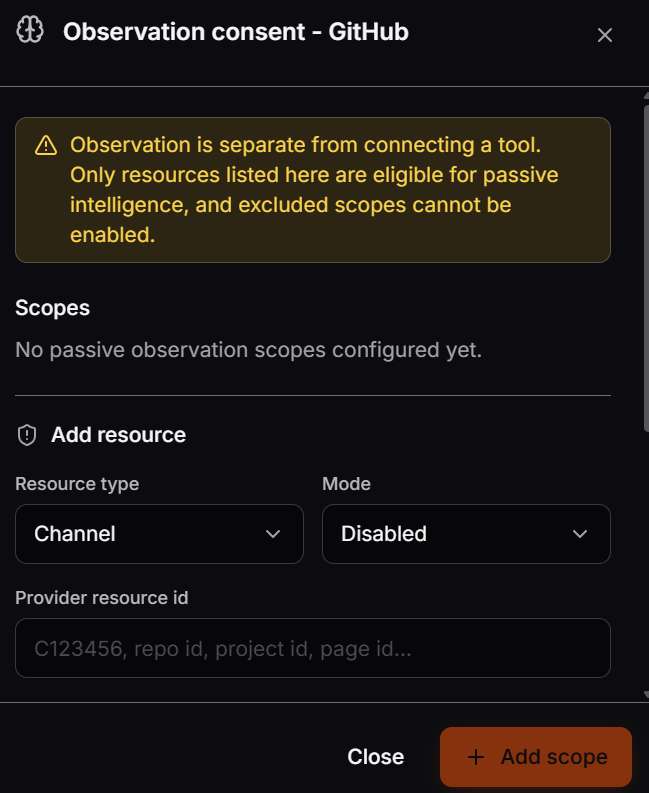 Observation is separate from connecting a tool. Only resources listed here are eligible for passive intelligence, and excluded scopes cannot be enabled.
## Open the drawer
In the Corunner web app, open **Integrations** and find the connected tool.
In the action row on the connected card, click the **brain** icon (tooltip: **Observation consent**). Only admins see the action row.
The **Scopes** list shows every resource that already has passive observation configured for this tool. A new connection shows *No passive observation scopes configured yet.*
## Add a resource
The **Add resource** form registers one specific resource inside the connected tool as an observation scope.
Observation is separate from connecting a tool. Only resources listed here are eligible for passive intelligence, and excluded scopes cannot be enabled.
## Open the drawer
In the Corunner web app, open **Integrations** and find the connected tool.
In the action row on the connected card, click the **brain** icon (tooltip: **Observation consent**). Only admins see the action row.
The **Scopes** list shows every resource that already has passive observation configured for this tool. A new connection shows *No passive observation scopes configured yet.*
## Add a resource
The **Add resource** form registers one specific resource inside the connected tool as an observation scope.
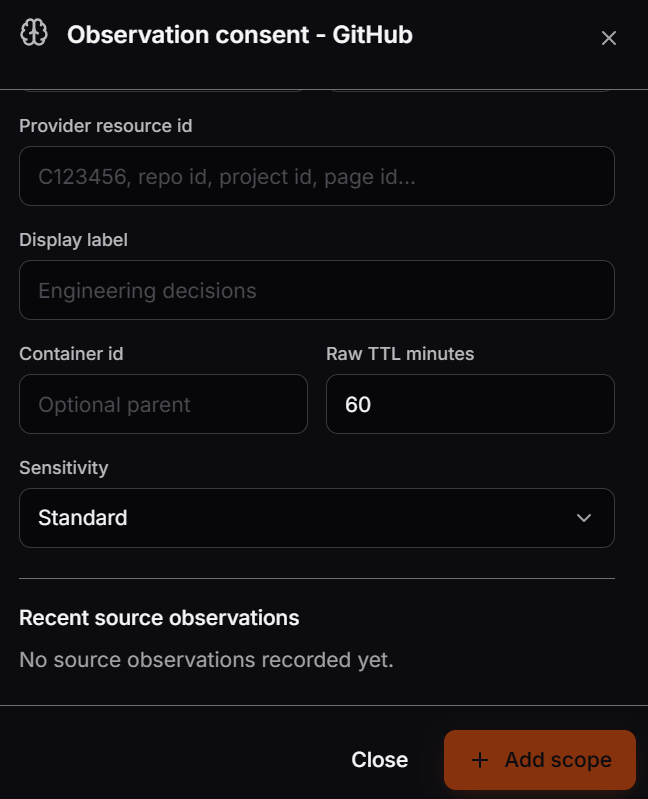 Pick what kind of resource this scope refers to: **Channel**, **Thread**, **Work item**, **Change request**, **Repository**, **Document**, **Meeting**, **Mailbox**, **Artifact**, or **MCP resource**.
Start in **Disabled** while you configure the scope, then switch to **Shadow** to observe without acting, or **Active** to let agents use the observations. **Excluded** sensitivity forces the mode to Disabled and cannot be enabled.
Paste the identifier the source system uses for the resource (Slack channel id such as `C123456`, a GitHub repo id, a Jira project id, a Confluence page id). This is the field the drawer uses to match incoming events to the scope.
Give the scope a recognizable name, such as **Engineering decisions**, so it is easier to identify in the Scopes list than by raw id.
Enter a parent identifier when the source system nests resources, for example a workspace id that contains many channels.
Enter how long, in minutes, Corunner keeps the raw observed content before it is removed. Must be between **1** and **1440** minutes. The default is **60**.
Select **Standard**, **Restricted**, or **Excluded**. **Excluded** blocks observation entirely and forces Mode to Disabled.
Corunner creates the scope. It appears in the **Scopes** list at the top of the drawer where you can adjust its mode or sensitivity later.
## Modes and sensitivity
| Mode | Behavior |
| - | - |
| **Disabled** | The scope is registered but no observations are recorded. |
| **Shadow** | Corunner observes and stores events for review, but agents do not act on them. |
| **Active** | Agents may use the observed events in their reasoning. |
| Sensitivity | Effect |
| - | - |
| **Standard** | Default handling. |
| **Restricted** | Extra handling constraints applied to stored observations. |
| **Excluded** | Observation is blocked. The scope is kept for auditing but Mode is forced to Disabled. |
Changing a scope's sensitivity to **Excluded** automatically switches its Mode to **Disabled**. You cannot re-enable the mode until you also change the sensitivity back.
## Recent source observations
The **Recent source observations** panel lists the events Corunner has already ingested against this connection's scopes. Each entry shows the external item id, resource type, event type, occurrence time, and processing status.
For each source observation you can:
* **Reprocess** — re-run ingestion for the item and reset its retry count. Requires a reason.
* **Purge** — remove the raw stored content for the item. Requires a reason and is destructive.
Both actions ask for a required reason before confirming, which is recorded for auditing.
## Related
Browse all Direct Connections that support Observation consent.
Review workspace-level policies that apply to observed content.
Pick what kind of resource this scope refers to: **Channel**, **Thread**, **Work item**, **Change request**, **Repository**, **Document**, **Meeting**, **Mailbox**, **Artifact**, or **MCP resource**.
Start in **Disabled** while you configure the scope, then switch to **Shadow** to observe without acting, or **Active** to let agents use the observations. **Excluded** sensitivity forces the mode to Disabled and cannot be enabled.
Paste the identifier the source system uses for the resource (Slack channel id such as `C123456`, a GitHub repo id, a Jira project id, a Confluence page id). This is the field the drawer uses to match incoming events to the scope.
Give the scope a recognizable name, such as **Engineering decisions**, so it is easier to identify in the Scopes list than by raw id.
Enter a parent identifier when the source system nests resources, for example a workspace id that contains many channels.
Enter how long, in minutes, Corunner keeps the raw observed content before it is removed. Must be between **1** and **1440** minutes. The default is **60**.
Select **Standard**, **Restricted**, or **Excluded**. **Excluded** blocks observation entirely and forces Mode to Disabled.
Corunner creates the scope. It appears in the **Scopes** list at the top of the drawer where you can adjust its mode or sensitivity later.
## Modes and sensitivity
| Mode | Behavior |
| - | - |
| **Disabled** | The scope is registered but no observations are recorded. |
| **Shadow** | Corunner observes and stores events for review, but agents do not act on them. |
| **Active** | Agents may use the observed events in their reasoning. |
| Sensitivity | Effect |
| - | - |
| **Standard** | Default handling. |
| **Restricted** | Extra handling constraints applied to stored observations. |
| **Excluded** | Observation is blocked. The scope is kept for auditing but Mode is forced to Disabled. |
Changing a scope's sensitivity to **Excluded** automatically switches its Mode to **Disabled**. You cannot re-enable the mode until you also change the sensitivity back.
## Recent source observations
The **Recent source observations** panel lists the events Corunner has already ingested against this connection's scopes. Each entry shows the external item id, resource type, event type, occurrence time, and processing status.
For each source observation you can:
* **Reprocess** — re-run ingestion for the item and reset its retry count. Requires a reason.
* **Purge** — remove the raw stored content for the item. Requires a reason and is destructive.
Both actions ask for a required reason before confirming, which is recorded for auditing.
## Related
Browse all Direct Connections that support Observation consent.
Review workspace-level policies that apply to observed content.